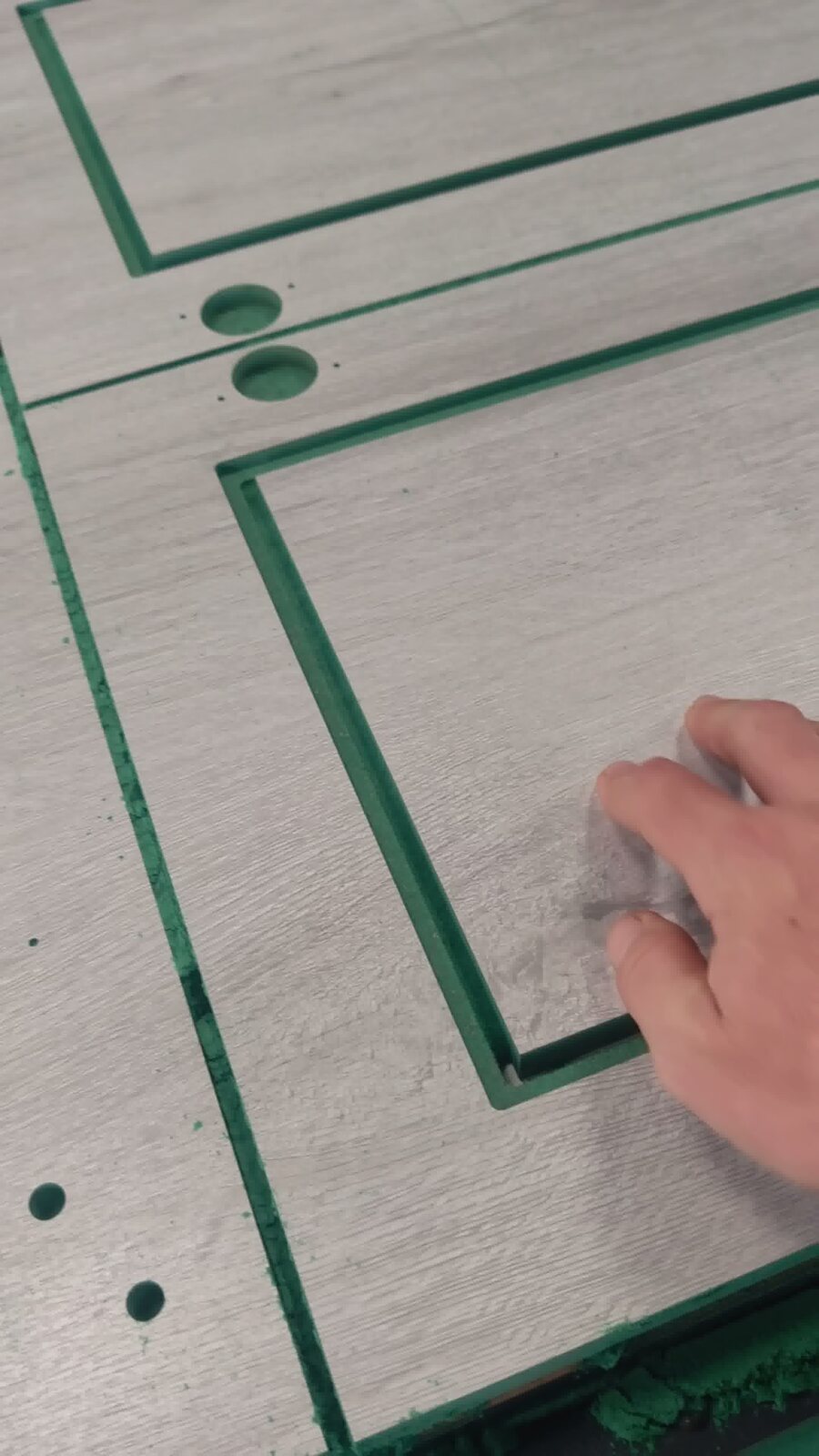
Two layouts containing the same parts can leave very different offcuts: many narrow strips in one, a useful continuous area in another.
Start with the usable area
Deduct edge trimming from the raw sheet and allow space for the tool between parts. A 2430 × 1230 mm sheet trimmed by 10 mm on every edge has a 2410 × 1210 mm usable area. Two 600 mm-wide parts with a 6 mm gap occupy 1206 mm.
Why rotation is not always allowed
Rotation is often possible on plain white board. With woodgrain, direction matters, and adjacent fronts may need a coordinated sequence. A useful layout must respect those constraints or material savings can spoil the appearance.
Utilisation and offcut shape
High utilisation helps, but judge the complete set of sheets. Where the parts allow it, fill earlier sheets and preserve a larger rectangular offcut on the last. Before cutting, the operator checks small-part holding, machining order and actual sheet defects.
Keep this checklist
Check before ordering
- Sheet size and trim are specified
- Tool clearance is included
- Decor direction is checked
Is a nesting diagram already a CNC program?
No. It is a placement plan. Toolpaths, workholding and machining sequence are confirmed separately before production.